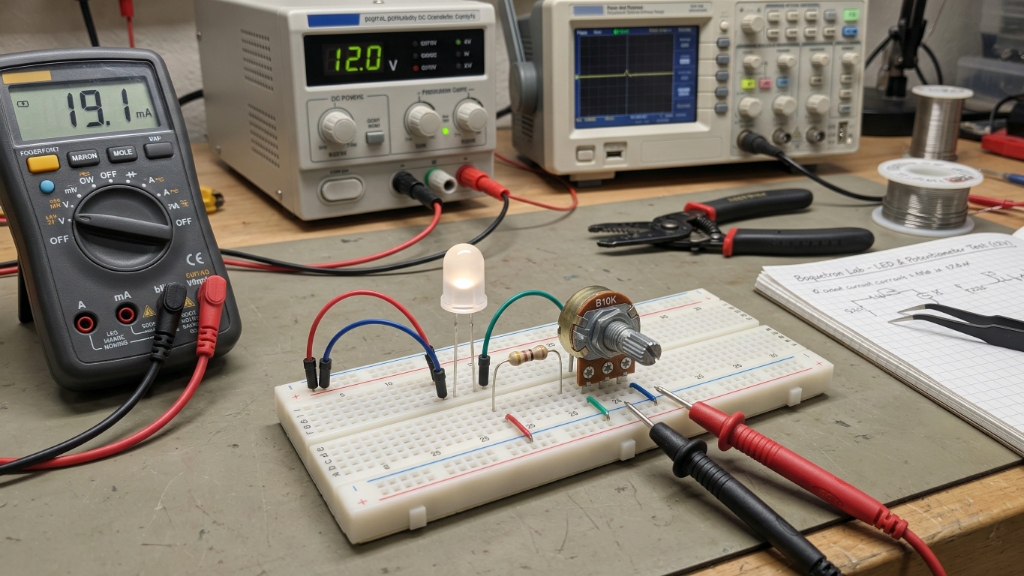
Welcome to Boquetron. This is the first post that launches not just a blog, but a methodology. Before any solder is dripped or any transistor is fried, here we follow a rigorous engineering approach:
- Theoretical Framework & Design: Here we define the objective and what we want to achieve with the project. Then, the circuit schematic is established with calculations.
- SPICE Simulation: The theoretical results are verified in the virtual realm. Schematic files will also be available for download.
- Physical Prototype & Validation: It is built on the bench and measured with oscilloscopes and multimeters.
Today, we tackle the “Hello World” of electronics: adjusting the brightness of an LED using a rheostat (variable resistor). It sounds trivial, but within this simplicity lies the essence of electrical engineering: protecting components and understanding fundamental laws.
1. Project Overview
Bienvenidos a Boquetron. Esta es la primera entrada que inaugura no solo un blog, sino una metodología. Antes de aplicar una sola gota de estaño o de quemar cualquier transistor, aquí seguimos una rigurosa disciplina de ingeniería:
- Marco Teórico y Diseño: Definimos el objetivo y establecemos el esquemático del circuito con sus cálculos.
- Simulación SPICE: Verificamos los resultados teóricos en el entorno virtual. Los archivos de esquemáticos estarán también disponibles para descarga.
- Prototipo Físico y Validación: Lo montamos en el banco de trabajo y lo medimos con osciloscopios y multímetros.
Hoy abordamos el «Hola Mundo» de la electrónica: ajustar el brillo de un LED utilizando un reóstato (resistencia variable). Parece trivial, pero dentro de esta sencillez reside la esencia de la ingeniería eléctrica: proteger los componentes y comprender las leyes fundamentales.